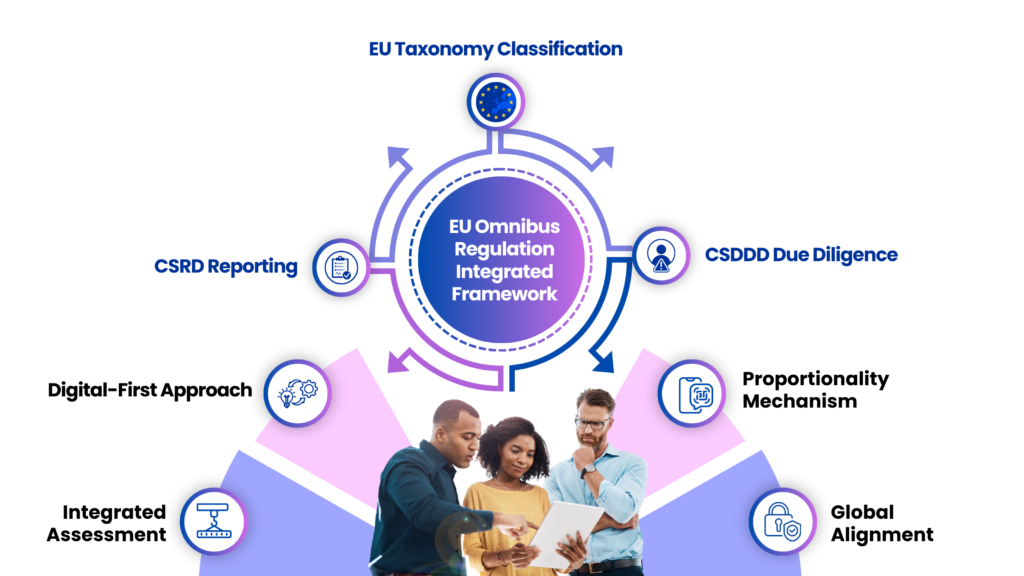
This white paper examines the European Union’s Omnibus Regulation, which represents a pivotal evolution in the EU’s sustainability regulatory framework. By analyzing whether this regulation is merely a repackaging of existing rules or a genuine innovation, we provide stakeholders with crucial insights for strategic compliance planning. Our findings suggest that while the Omnibus Regulation builds upon established principles, it introduces transformative changes that will fundamentally reshape corporate sustainability practices across Europe and globally.

Introduction

The European Union stands as a global leader in sustainability regulation, continually refining its approach to ensure environmental responsibility and corporate transparency. The EU Omnibus Regulation represents a watershed moment in this journey—an ambitious attempt to streamline existing sustainability frameworks while maintaining their effectiveness.

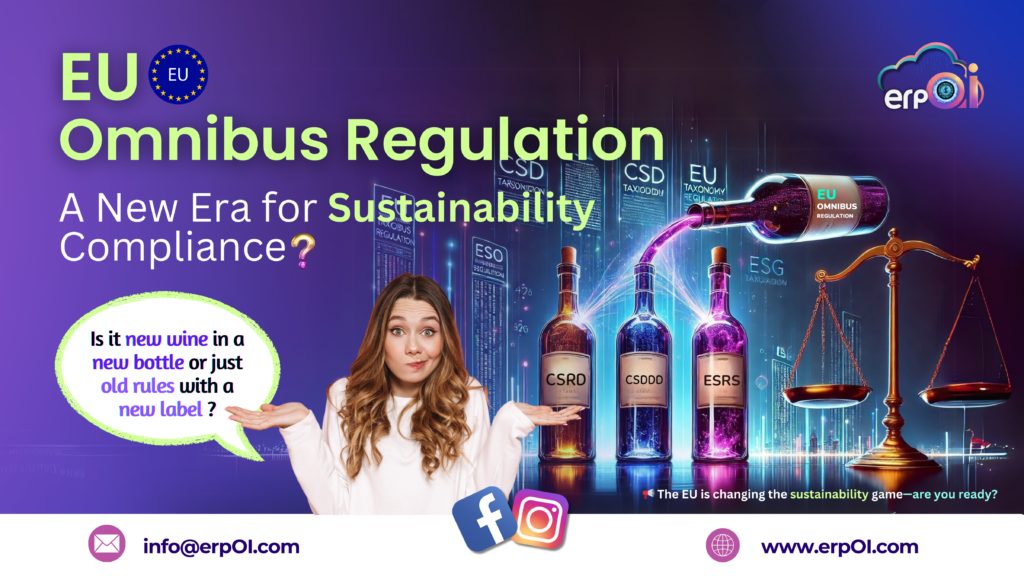
This paper examines whether the Omnibus Regulation is simply “old wine in a new bottle”—a mere rebranding of existing regulations—or “new wine in a new bottle”—a genuinely innovative approach to sustainability governance. By analyzing its relationship with the Corporate Sustainability Reporting Directive (CSRD), the Corporate Sustainability Due Diligence Directive (CSDDD), and the EU Taxonomy for Sustainable Activities, we provide a comprehensive assessment of its impact on businesses within and beyond the EU.

The Current Regulatory Landscape

Corporate Sustainability Reporting Directive (CSRD)

The CSRD represents a significant enhancement over previous non-financial reporting requirements, expanding both scope and substance in sustainability disclosures.

Purpose and Philosophy

The CSRD aims to transform corporate transparency by institutionalizing sustainability as a core reporting obligation alongside financial performance. This reflects the growing recognition that environmental, social, and governance (ESG) factors are material to corporate value creation and risk management.

Comprehensive Scope

Rigorous Requirements

Implementation Timeline

Corporate Sustainability Due Diligence Directive (CSDDD)

The CSDDD creates a legally binding framework for proactive management of adverse impacts across global value chains.

Purpose and Philosophy

The CSDDD institutionalizes human rights and environmental due diligence as a legal obligation rather than a voluntary commitment. It operationalizes the United Nations Guiding Principles on Business and Human Rights and the OECD Guidelines for Multinational Enterprises.

Strategic Scope

Core Requirements

Phased Implementation

EU Taxonomy for Sustainable Activities

Purpose and Philosophy

The Taxonomy creates a common language for sustainable finance, enabling capital markets to identify and support environmentally sustainable investments, thereby facilitating the transition to a low-carbon, resilient and resource-efficient economy.

Technical Criteria Framework

Continuous Development Timeline

The EU Omnibus Regulation: Evolutionary or Revolutionary?

Genesis and Motivation

The Omnibus Regulation emerges from a recognition that while individual sustainability regulations serve valuable purposes, their cumulative effect creates significant compliance challenges. This initiative responds to stakeholder feedback highlighting regulatory overlap, inconsistent terminology, and disproportionate burdens on smaller enterprises.

Transformative Objectives

Key Innovations

Impact Analysis: Winners and Challenges

Positive Transformations

Implementation Challenges

Strategic Response Framework for Organizations

Immediate Priorities (0-6 months)

Medium-Term Actions (6-18 months)

Long-Term Strategic Positioning (18+ months)

Is It Old Wine or New Wine?

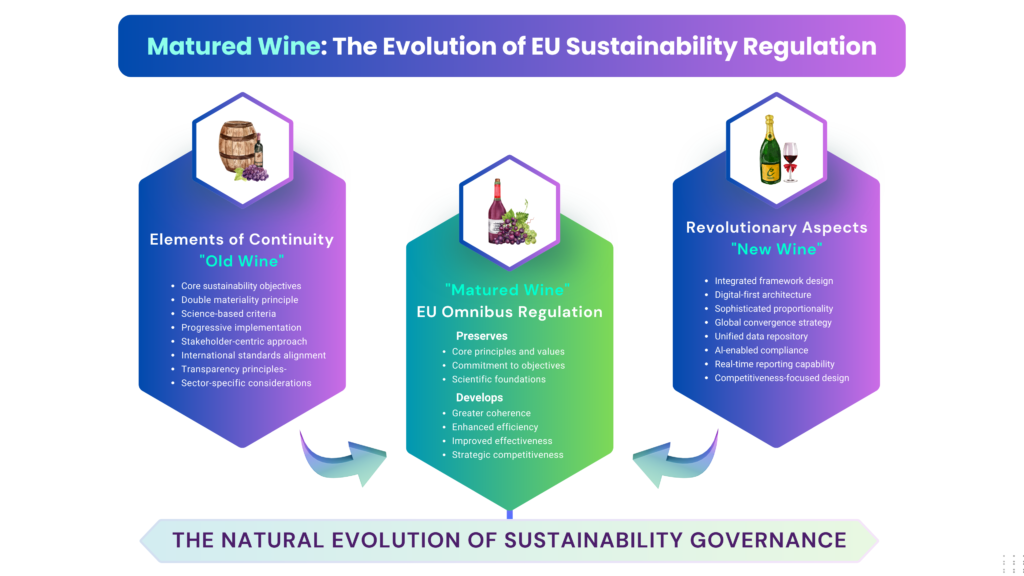
The EU Omnibus Regulation represents both continuity and innovation—neither purely old wine in a new bottle nor entirely new wine. It maintains the fundamental principles and objectives of existing frameworks while introducing transformative changes in implementation approach.

Conclusion: A Maturation of EU Sustainability Regulation

The EU Omnibus Regulation represents a maturation of the European approach to sustainability governance—evolving from parallel initiatives to an integrated ecosystem. This evolution reflects growing recognition that sustainability challenges require coherent, efficient regulatory frameworks that balance ambition with practicality.

For businesses, the regulation offers both challenge and opportunity. Those viewing it merely as a compliance exercise will focus on the transitional difficulties. However, organizations that recognize it as a catalyst for strategic transformation will find competitive advantage in its implementation.

The question of “old wine or new wine” ultimately misses the point. The EU Omnibus Regulation represents something more significant—the natural evolution of sustainability governance toward greater coherence, efficiency, and effectiveness. In this sense, it might be better characterized as “matured wine”—one that preserves the essential character of its origins while developing greater sophistication and balance over time.

AUTHORS

At erpOI, we specialize in guiding organizations through complex regulatory transitions. Our team of sustainability experts combines deep regulatory knowledge with practical implementation experience to help clients not just comply with regulations like the EU Omnibus, but to strategically position themselves for competitive advantage.

We offer comprehensive support services including:

  • Gap assessments and readiness evaluations
  • Integrated compliance roadmap development
  • Data architecture and system integration
  • Training and capability building
  • Ongoing regulatory monitoring and updates

Contact us to learn how we can help your organization navigate the evolving sustainability landscape with confidence and strategic vision.

Contact Information

For Further Inquiries

www.erpOI.com | Info@erpOI.com | Offices in Sweden, India & UAE

Leave a Reply

Your email address will not be published. Required fields are marked *