
- Home
- Our Offerings
- Partners
- Insights
- Contact Us
EU Omnibus Regulation - Old Wine in New Bottle or New Wine in New Bottle?
The European Union stands as a global leader in sustainability regulation, continually refining its approach to ensure environmental responsibility and corporate transparency. The EU Omnibus Regulation represents a watershed moment in this journey—an ambitious attempt to streamline existing sustainability frameworks while maintaining their effectiveness.This paper examines whether the Omnibus Regulation is simply “old wine in a new bottle”—a mere rebranding of existing regulations—or “new wine in a new bottle”—a genuinely innovative approach to sustainability governance. By analyzing its relationship with the Corporate Sustainability Reporting Directive (CSRD), the Corporate Sustainability Due Diligence Directive (CSDDD), and the EU Taxonomy for Sustainable Activities, we provide a comprehensive assessment of its impact on businesses within and beyond the EU.
This white paper examines the European Union’s Omnibus Regulation, which represents a pivotal evolution in the EU’s sustainability regulatory framework. By analyzing whether this regulation is merely a repackaging of existing rules or a genuine innovation, we provide stakeholders with crucial insights for strategic compliance planning. Our findings suggest that while the Omnibus Regulation builds upon established principles, it introduces transformative changes that will fundamentally reshape corporate sustainability practices across Europe and globally.
Introduction
The European Union stands as a global leader in sustainability regulation, continually refining its approach to ensure environmental responsibility and corporate transparency. The EU Omnibus Regulation represents a watershed moment in this journey—an ambitious attempt to streamline existing sustainability frameworks while maintaining their effectiveness.

This paper examines whether the Omnibus Regulation is simply “old wine in a new bottle”—a mere rebranding of existing regulations—or “new wine in a new bottle”—a genuinely innovative approach to sustainability governance. By analyzing its relationship with the Corporate Sustainability Reporting Directive (CSRD), the Corporate Sustainability Due Diligence Directive (CSDDD), and the EU Taxonomy for Sustainable Activities, we provide a comprehensive assessment of its impact on businesses within and beyond the EU.
The Current Regulatory Landscape
Corporate Sustainability Reporting Directive (CSRD)
The CSRD represents a significant enhancement over previous non-financial reporting requirements, expanding both scope and substance in sustainability disclosures.
Purpose and Philosophy
The CSRD aims to transform corporate transparency by institutionalizing sustainability as a core reporting obligation alongside financial performance. This reflects the growing recognition that environmental, social, and governance (ESG) factors are material to corporate value creation and risk management.
Comprehensive Scope
EU-listed companies:
All companies listed on EU regulated markets
Large companies:
Entities meeting at least two of three criteria: €40M+ revenue, €20M+ assets, 250+ employees
EU subsidiaries of non-EU companies:
With significant EU operations (€150M+ EU revenue)
Total coverage:
Approximately 50,000 companies, a fourfold increase from previous requirements
Rigorous Requirements
Double materiality approach:
Companies must report on both impacts on sustainability matters and how sustainability issues affect the company
European Sustainability Reporting Standards (ESRS):
Mandatory sector-agnostic and sector-specific standards
Independent assurance:
Initially limited assurance, progressing to reasonable assurance
Digital tagging:
Machine-readable format compatible with the European Single Access Point
Implementation Timeline
January 1, 2024
Large public companies with 500+ employees (FY2024, reporting in 2025)
January 1, 2025
All other large companies (FY2025, reporting in 2026)
January 1, 2026
Listed SMEs, small non-complex financial institutions, and captive insurance companies (with opt-out until 2028)
Corporate Sustainability Due Diligence Directive (CSDDD)
The CSDDD creates a legally binding framework for proactive management of adverse impacts across global value chains.

Purpose and Philosophy
The CSDDD institutionalizes human rights and environmental due diligence as a legal obligation rather than a voluntary commitment. It operationalizes the United Nations Guiding Principles on Business and Human Rights and the OECD Guidelines for Multinational Enterprises.
Strategic Scope
Group 1 companies
Companies must report on both impacts on sustainability matters and how sustainability issues affect the company
Group 2 companies
Non-EU companies with €450M+ EU turnover |
High-impact sectors
Modified thresholds for companies in sectors with heightened risks
Cascading effect
While directly applicable to approximately 5,000 companies, the due diligence requirements cascade through value chains, affecting millions of businesses worldwide |
Core Requirements
Comprehensive due diligence obligation
Identify, prevent, mitigate, and account for actual and potential adverse impacts
Integration into corporate governance
Embed due diligence into policies, risk management, and decision-making processes
Stakeholder engagement
Consultation with affected communities, workers, and other relevant parties
Access to remedy
Establishing grievance mechanisms and providing remediation when appropriate
Climate transition planning
Adoption of science-based plans aligned with the Paris Agreement
Phased Implementation
2027
Companies must report on both impacts on sustainability matters and how sustainability issues affect the company
2028
Non-EU companies with €450M+ EU turnover
2029
Modified thresholds for companies in sectors with heightened risks |
EU Taxonomy for Sustainable Activities
The EU Taxonomy serves as the foundation for the European sustainable finance architecture, providing a science-based classification system for environmentally sustainable economic activities.
Purpose and Philosophy
The Taxonomy creates a common language for sustainable finance, enabling capital markets to identify and support environmentally sustainable investments, thereby facilitating the transition to a low-carbon, resilient and resource-efficient economy.
Universal Scope
- Financial market participants: Including asset managers, institutional investors, and banks
- Large public-interest companies: Subject to CSRD requirements
- EU and Member State authorities: When establishing public measures, standards, or labels
Technical Criteria Framework
Six environmental objectives
- Climate change mitigation
- Climate change adaptation
- Sustainable use and protection of water and marine resources
- Transition to a circular economy
- Pollution prevention and control
- Protection and restoration of biodiversity and ecosystems
Technical screening criteria
Detailed, science-based thresholds and metrics
Do No Significant Harm (DNSH) principle
Activities must not undermine other environmental objectives
Minimum social safeguards
Alignment with international standards such as the ILO Fundamental Conventions
Continuous Development Timeline
2021
Climate Delegated Act (climate mitigation and adaptation)
2022
Complementary Climate Delegated Act (nuclear and natural gas) |
2023
Environmental Delegated Act (remaining four objectives) |
Ongoing
Regular review and refinement of technical screening criteria
The EU Omnibus Regulation: Evolutionary or Revolutionary?
Genesis and Motivation
The Omnibus Regulation emerges from a recognition that while individual sustainability regulations serve valuable purposes, their cumulative effect creates significant compliance challenges. This initiative responds to stakeholder feedback highlighting regulatory overlap, inconsistent terminology, and disproportionate burdens on smaller enterprises.
Transformative Objectives
1. Regulatory Streamlining
The Omnibus Regulation aims to create a coherent sustainability framework by:
- Eliminating redundant reporting requirements across directives
- Harmonizing terminology and concepts
- Creating a unified compliance timeline
- Establishing a centralized data repository
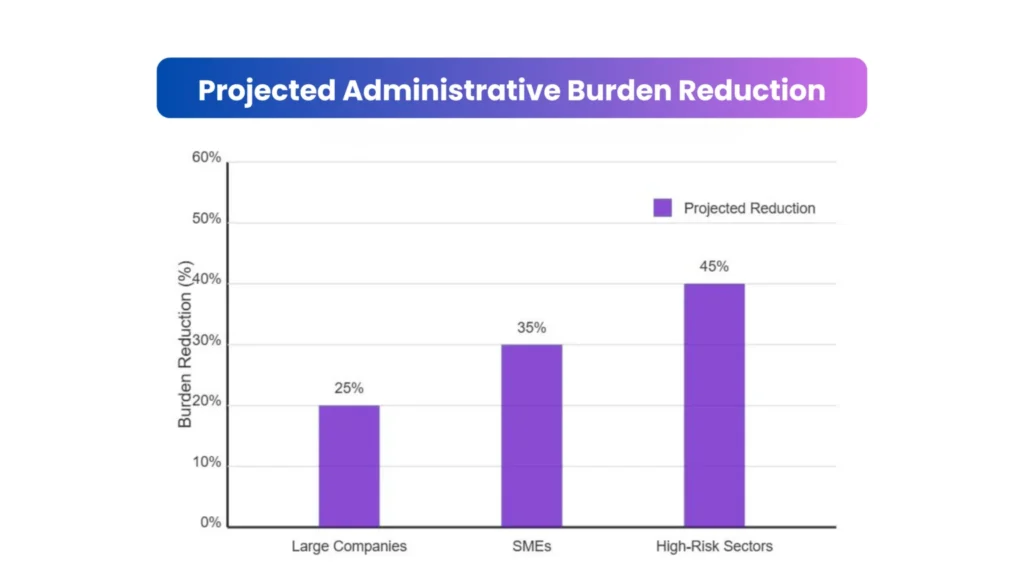
2. Burden Reduction
Concrete targets for administrative relief include:
- 25% reduction in reporting requirements for large companies
- 35% reduction for SMEs
- Simplified verification procedures
- Proportionate implementation based on company size and risk profile
3. Enhanced Effectiveness
Rather than diluting sustainability objectives, the Omnibus approach seeks to enhance effectiveness through:
- Improved data quality through consolidated reporting
- Better resource allocation toward material issues
- Enhanced comparability of sustainability information
- More integrated connection between disclosure and due diligence
Transformative Objectives
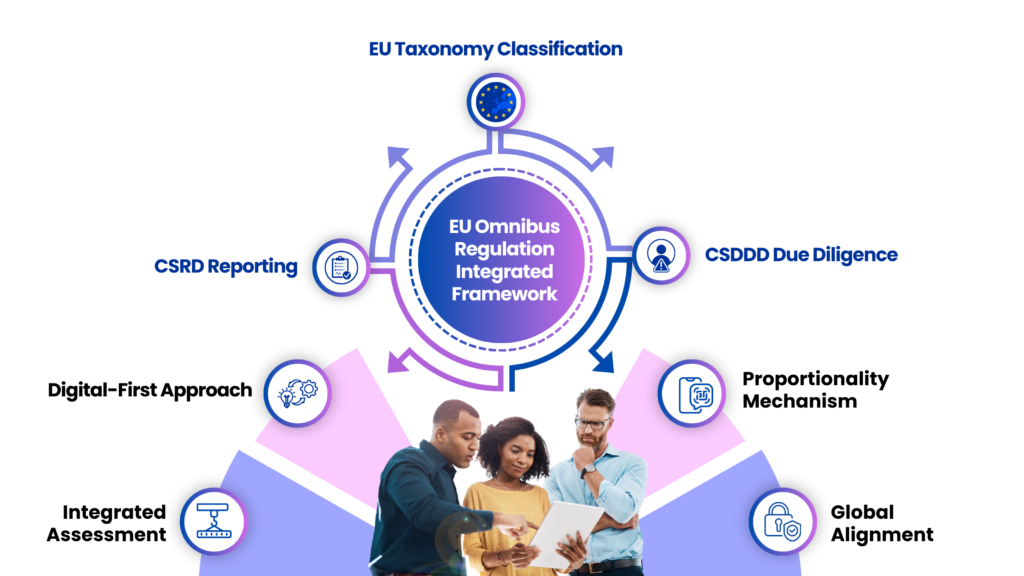
1. Integrated Assessment Framework
The Omnibus Regulation introduces a unified approach to sustainability assessment that:
- Connects reporting obligations with due diligence processes
- Aligns impact assessment methodologies with Taxonomy criteria
- Creates a “comply once, report many times” model
- Facilitates interoperability across different reporting frameworks
2. Digital-First Approach
Building on the European Single Access Point (ESAP) initiative, the regulation embraces digital transformation through:
- Standardized machine-readable formats
- Automated compliance checking
- Dynamic reporting capabilities
- Blockchain-based verification options
3. Proportionality Mechanism
Recognizing diverse business realities, the regulation introduces sophisticated proportionality through:
- Risk-based reporting requirements
- Sector-specific materiality guidance
- Simplified standards for non-complex entities
- Progressive implementation pathways
4. Global Alignment Strategy
The regulation positions EU standards within the international landscape by:
- Creating interoperability with ISSB standards
- Establishing equivalence mechanisms for third-country frameworks
- Supporting global convergence through the G7 and G20
- Facilitating mutual recognition arrangements

Company
Our Offerings
Our Offices
Sweden - Ulvsbergsvagen 17B, Tullinge, 14654 Stockholm
India - Lodha Signet 1, Dombivali 421204
Email:
© 2025 All rights reserved.